
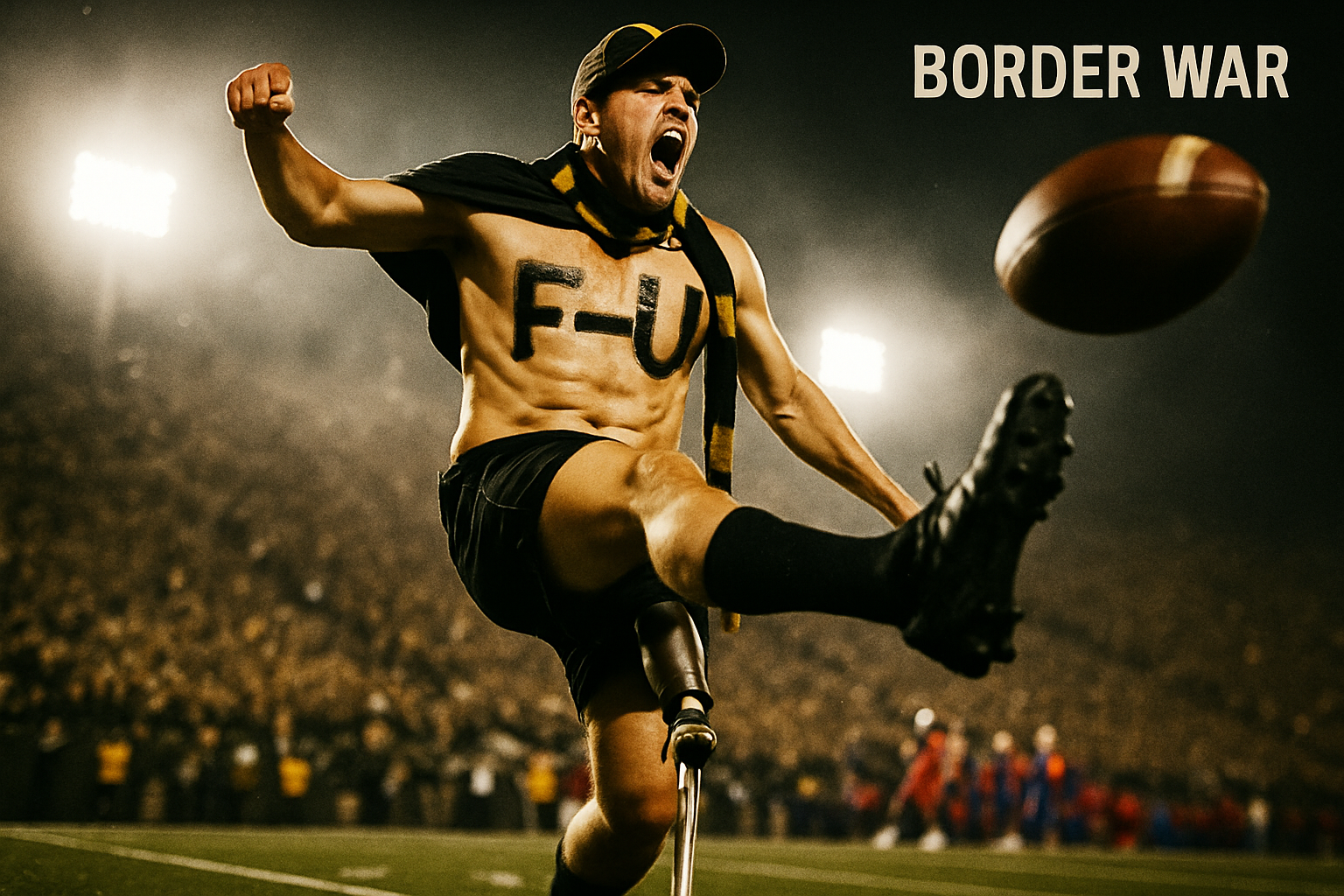
Opening chaos at Faurot Field
The scoreboard read 21-21, the clock was doing its best impression of a cliffhanger, and somewhere between the concession stand and a wave of nervous students, someone decided that conventional entertainment was underrated. A Mizzou fan was marched onto the turf to attempt a 45-yard field goal for a modest little prize of $25,000 — the sort of thing that usually ends with hugs, high fives, a ceremonial check, and maybe a sore calf the next morning.
This time, however, the check never got its moment in the sun. Instead a shirt was lifted, a chest was painted, a prosthetic leg made a cameo, and the ball was not so much booted as theatrically redirected into the political geography of fandom. The message on the chest read “F KU” — blunt, politically incorrect, and calibrated to get a rise from anyone wearing crimson and blue. The ball did not travel toward points so much as toward an opposing sideline, which made the $25k prize look like an afterthought and the stunt the overnight headline.
Fans roared. Phones recorded. Security took notes.
Meet the man who walked onto the field
He remains unidentified, which in modern viral culture is a boon. Mystery breeds legend. Mystery also shields one from official letters, but that’s getting ahead of ourselves.
He had a prosthetic leg, which is important because it gave the whole spectacle a slightly surreal movie-quality twist. Not tragic, not triumphant, just strangely cinematic — like a character walking out of a Western with a grin and a body paint designer on speed dial.
You could call him brave, foolish, theatrical, or all three at once. You could also call him the kind of person who reads rules and then interprets them as suggestions. Whatever label you pick, he turned a commercial promotional moment into an improvisational performance piece. And let’s be honest, performers who steal the stage at football games generally do get remembered.
Short and to the point:
Border War, baby.
The $25k kick that was supposed to be a feel‑good promo
There’s a corporate life cycle for these promotional field kicks: pick a fan, set the distance, allow a hearty beep of encouragement, hand over money, pose for photos, rinse and repeat until halftime. Sponsors smile. Organizers breathe a sigh of satisfaction. The crowd cheers. It’s wholesome, corporate, very middle-of-the-road.
This particular moment began exactly like that. The staff picked a fan. He strode onto the turf. The announcer read the script. The stadium prepared to pay out. And then the script went out the window.
The rulebook for such events probably includes clauses about safety, scheduling, and the proper angle for awkward local news inserts. It almost certainly does not include clauses about political chest paintings or how to aim the ball as a semantic punctuation mark. So what was supposed to be a tidy prize giveaway instead became a theatrical act with a one-man creative direction.
The reveal that stole the show
Body paint theatrics and the prosthetic leg cameo
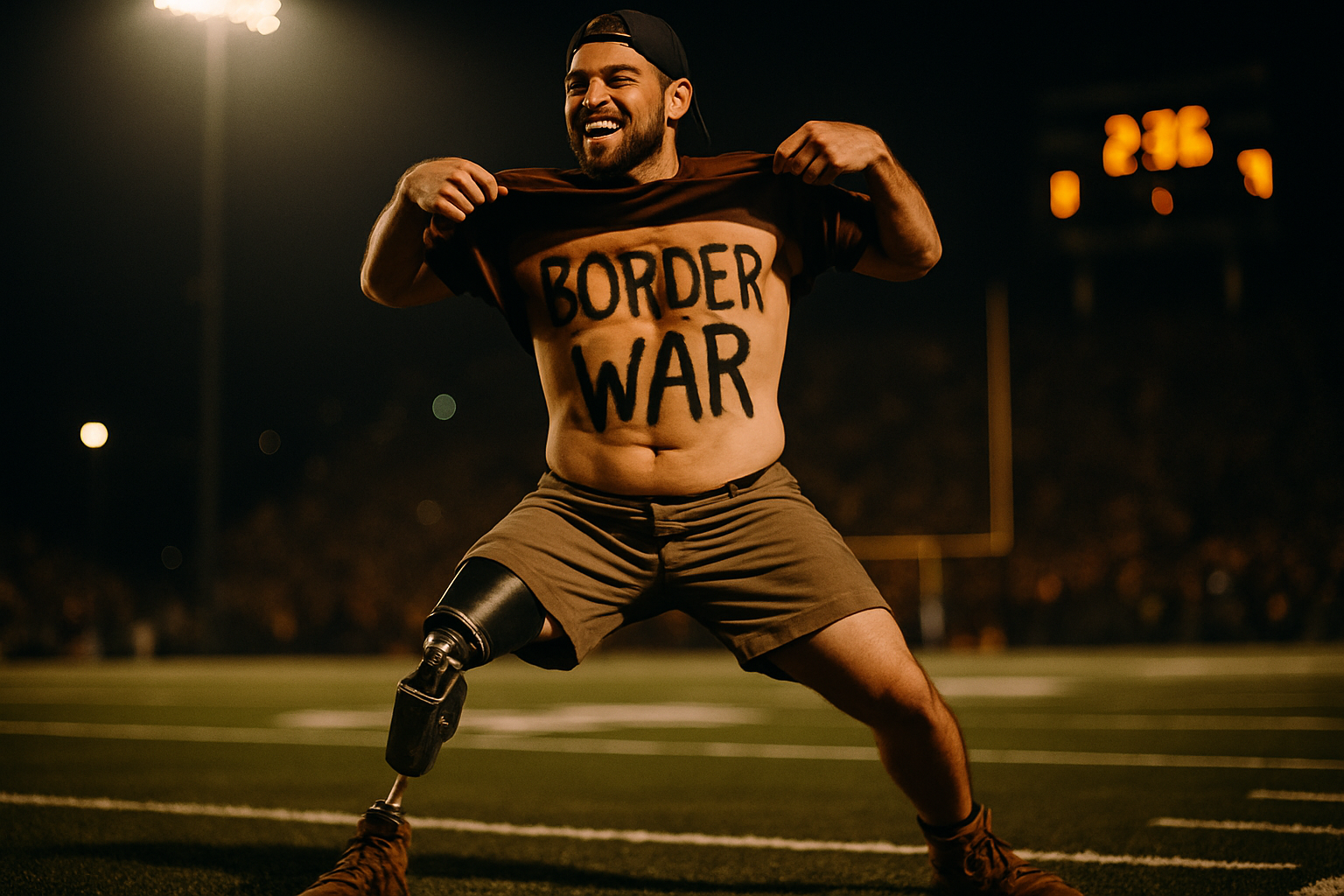
The reveal was simple: lift the shirt, show the paint, hold the audience. The prosthetic leg was not an accessory; it was a statement that this wasn’t a commercial. It was performance art with a sports penalty attached if the referees wanted to get involved.
It was also a masterclass in economy: one succinct message, two lifts of a shirt, one prosthetic for texture, and a grin. A lot of people stood there trying to figure out if they’d just witnessed passion, bad taste, or marketing genius. Some chose all three.
Short para: theatrical, loud, unforgettable.
The kick aimed at the opposing sideline
Instead of sending the ball sailing between the uprights, he sent it toward the Kansas sideline. That choice was the stunt’s punchline. The physics of a misdirected field goal meet the theater of the rivalry. He lifted his shirt again after the kick. The crowd reacted as if watching a magician reveal both the rabbit and the cape trick at once.
This was tactical anti-scoring. The crowd loved it. The Kansas side likely had mixed feelings. Security began choreography that would later look like an embarrassed but practiced ballet: approach, escort, explanation.
How the stunt lit up X and the internet
Praise from fans who loved the unfiltered passion
Social feeds filled rapidly with clips, screenshots, and folks declaring allegiance to whatever side of the moral fence they preferred. Some praised the move as pure, unfiltered fandom — the kind that prefers insults to polite neutrality. Comments poured in: “Perfect rivalry move” and “Border War, baby” were among the gentler takes.
Fans who love raw emotion in sports saw it as an extension of the game’s theatrical side. The fan had conveyed a sentiment that many people feel after a touchdown or a bad call, only he expressed it with more body paint and less subtlety.
Short para: viral energy was immediate.
Memes and hot takes from the usual suspects
Where fans praise, the internet memes follow. Creators cropped, dubbed, and overlaid the clip with everything from classical music to mocking sound effects. Hot takes rolled in: some denounced the stunt as classless, others celebrated it as quintessential rivalry culture. Pundits argued about discipline. Memes argued about physics.
Naturally, a Barstool tweet and assorted sports accounts elevated the moment into a little holiday of content. The amateur director of the stunt suddenly had better production values than half of late-night TV.
Why the Border War exists and why it still matters
A quick jog through Civil War era animosity and rivalry lore
The Missouri-Kansas rivalry goes back much further than pep bands and halftime promotions. The “Border War” nomenclature nods to real 19th-century conflicts and a period when state lines and loyalties involved more than a college mascot. That history filters down through generations of alumni grudges, high school bragging rights, and local newspaper columns that are unusually verbose.
These ancestral quarrels are the fuel for modern-day rivalry antics. It’s historical grudges playing out on the field and then amplified on handheld devices.
Why college rivalries invite theatrical nonsense
College rivalry culture is basically sanctioned chaos with cheerleaders. It’s an ecosystem that rewards elaborate signs, coordinated heckling, and sometimes barbecue-fueled creativity. The stakes are both lower and higher than professional sports: lower because nobody loses their contract; higher because identity and school pride are at stake.
When those identities collide, people tend to invent colorful ways to express contempt or affection. A painted chest is an extreme version of a fan-made sign. It’s louder and costlier than a foam finger. That’s really the point.
Immediate consequences and possible fallout
The escorted off field moment and security choreography
After the kick, security moved in like stagehands clearing a set. The execution was efficient, practiced, and mildly humiliating for the performer. He was escorted off, which is how the evening ended for him before the legal and PR plotlines even got to their first act.
The choreography looked like a practiced routine: two steps in, one step out, polite but firm. No wrestling, no dramatic tackles. Just a gentle removal, the kind you imagine in a comedy where the guy gets a slightly bruised ego and a robust social media resume.
Potential fines, school discipline, and PR headaches
Now the fun wears a slightly different shade. The school might face fines from the league if rules about field access or signage were broken. The individual could face civil or campus disciplinary action. Sponsors might squint at footage and wonder why their brand was adjacent to an expletive.
PR teams will issue statements that sound both concerned and oddly proud of the spectacle. Lawyers will sniff. The stadium will review procedures. And the $25k? It’s unclear whether he’ll ever see it — prize-winning may require compliance with every clause in the small-print contract.
Short para: chaos has costs.
The anatomy of a perfect rivalry stunt
Why this hit the sweet spot between audacity and comedy
Timing, clarity, and relatability made this work. The timing: late, decisive, and emotionally charged. The clarity: a single, legible message painted on human canvas. The relatability: everyone has wanted to yell something rude at a rival at least once. Combine those, add a prosthetic leg cameo for cinematic flair, and the stunt becomes more than an insult — it becomes content.
It had a joke structure: set up, reveal, punchline. It also respected certain invisible boundaries: nobody was harmed, no property was destroyed, and the joke was direct and easy to repost.
Where it could have gone terribly wrong
This was a tightrope walk. If someone had been injured, if fans had rushed the field, if the message had been more incendiary or targeted at a protected class, it would have been a different headline. Arrests, lawsuits, or a genuine brawl would have turned this into a cautionary tale.
Worst case scenarios included felony trespass charges, civil suits from offended parties, or a PR fallout that sank a sponsor’s season. The stunt succeeded because it flirted with danger without crossing into actual harm.
What this says about fan culture and modern sports theater

Stunts like this reveal that fandom is half sport, half performance art. People want to be seen, remembered, and retweeted. The boundaries between spectacle and competition blur when social currency becomes as valuable as points on a scoreboard.
Fans increasingly perform for two audiences at once: the 60,000 in the stadium and the infinite scroll of the internet. That double act changes behavior. Humans used to shout at the game. Now they craft moments to travel.
Short para: fandom evolves. Theatrics remain.
Final punchline and takeaways for $25k kicks and cheap thrills
The stunt was cheap, loud, and effective. It did not win the $25k, at least not in the way the sponsor intended. It did win headlines, memes, and a place in rivalry lore. It is the kind of thing that existing alumni will tell grandchildren about, adding a little flourish each time.
So what did we learn? Fans will always improvise. Security will always rehearse. History will always give rivalries a fuel source. And someone somewhere will decide that $25k is worth being very memorable.
One lasting truth: if you’re planning to substitute points with performance, bring a lawyer or at least a good publicist.

